
Best Exercises for Full Body: 15 Powerful Workouts for Better Fitness

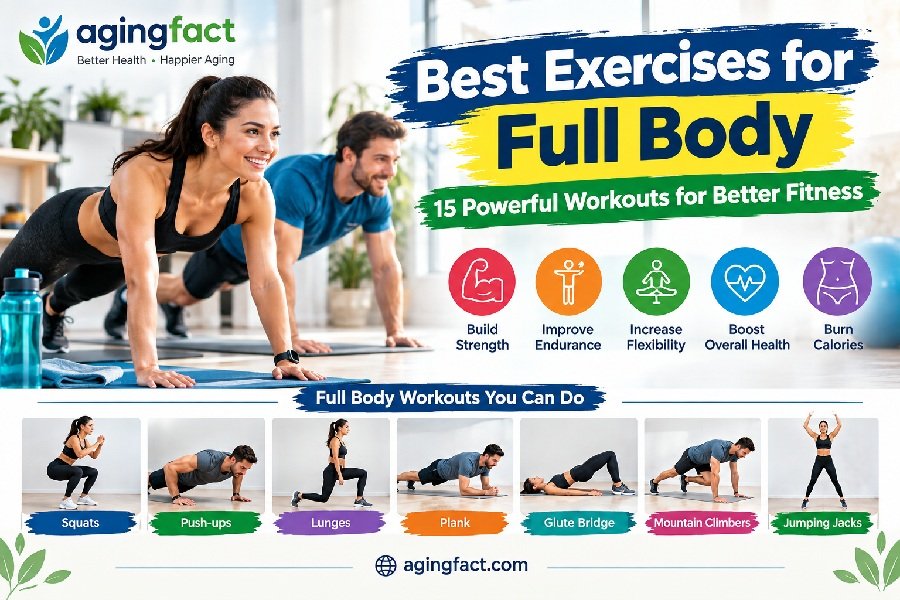
Want to feel better, improve health, and reduce your risk of injury? Stay active and moving. You don’t have to spend hundreds of dollars a year to find ways to be active. Some of the best methods to improve your health are also free. These include walking, bodyweight exercises, and training with external resistance.
Adults, including older adults, should engage in cardiovascular exercise for a minimum of 150 minutes each week and participate in strength training activities at least twice a week.
Many unconditioned and out-of-shape adults have the biggest issue of starting too much too soon. You must be patient and understanding when starting your new active lifestyle and give your body time to adjust.
The goal of training should be improving your cardiovascular system and muscular system. Adding flexibility and stability training should be incorporated as well.
Most activities and exercises available allow for improvement in multiple areas. We will give examples to aid in your planning to ensure your workouts for the week are comprehensive.
Key Facts
All forms of exercise have numerous benefits. The examples listed here are just a few.
Lower body strength training activities include: lunges and squats.
Core strength and abdominal training activities include: crunches and sit-ups.
Chest, shoulders, and triceps can be strengthened with a modified push-up.
Balance can be improved with the use of a single leg stance.
Older adults may have increased difficulties with activities that require balance.
Modifications can be made to activities to increase or decrease their overall difficulty.
Generally, frequent shorter workouts are more beneficial than infrequent extremely long workouts.
What Is a Full-Body Workout?
An example of a full-body workout is:
Walking, which provides cardio vascular fitness.
Squats, or sit-to-stands, to provide leg fitness.
Wall push-ups to provide upper body fitness.
Rowing to provide back fitness.
Core fitness exercises.
Fitness exercises to provide balance.
Gentle stretching.
The National Institute on Aging states that the term “physical activity” encompasses several different forms of exercise, including aerobic exercise, muscle-strengthening activities, and exercises that improve balance and flexibility. The benefits of exercise are heightened when the various components of physical activity are incorporated in an individual’s exercise program.
It is time efficient to perform several exercise movements that work various body parts and muscle groups in a single exercise session. Traditionally, exercises are performed in a session dedicated to work out a particular body part.
15 Best Exercises for Full Body
1. Walking
Walking is low impact and an easy way to get an aerobic workout, strengthen and condition the body. It can be done indoors or out and does not require any special equipment.
To Get Started
Make it your goal to walk for 10-15 minutes at a time. You can increase your time or distance once it becomes easier to achieve your goal.
It is better to break your activity up into shorter sessions if that is all you can manage at first. Any activity is better than none. The CDC agrees.
2. Chair Squats
Chair squats are often used when working with older adults because squatting down to a position and then back up again gives them a point of reference.
Technique
Find a sturdy chair.
Position your feet about hip width apart.
Bend your knees and hips and squat down until you are about to sit on the chair.
Touch the chair if you can and then stand back up.
This exercise practices hip and leg strength. It is similar to an activity we all do numerous times a day, like getting up from a chair.
The NIA says muscle strengthening activities, like the one we are practicing, help adults do activities such as getting up from chairs.
3. Wall Push-Ups
Altering the body position for a traditional push-up can be difficult for some people. A more simple variation is to push-up against a wall.
How to Do This
Find a wall.
Place your hands against the wall.
Bend your elbows and bring your chest to the wall.
Push yourself away from the wall.
Wall push-ups are a good alternative to traditional push-ups because they work the chest and arms more. Wall push-ups also force you to stabilize your trunk, working your core.
Depending on your level of fitness, you may find wall push-ups too easy and move on to more difficult variations of the push-up.
4. Resistance Band Rows
Full body workouts are easy to do with resistance bands because they are small and easy to take with you.
For upper back and shoulders: do a band row by pulling the band to your body and squeezing your shoulder blades.
Of course you want to avoid jerky or uncontrolled movements as much as possible.
5. Glute Bridges
To perform Glute Bridges, lift your hips while keeping your knees and feet everywhere they are supposed to be.
If you have problems with getting into this starting position or getting back to the starting position after your set, then this exercise probably is not the best to strengthen your glutes and you probably should ask a Physical Therapist to help you.
6. Step-Ups
Always hold onto the handrail for balance.
Step-Ups work your quads, but a lower step makes it easier to work your glutes as well.
Basic Movement
To perform this exercise, bring one leg to the step and push through the leg to bring your other leg to the step and step down. Repeat on the other leg.
When first beginning this exercise, you may want to use a lower step.
This exercise will help improve the legs and hips and challenged the sense of balance and body coordination.
If you don’t feel balanced enough to perform this exercise, you can pick a different exercise to do.
7. Standing Calf Raises
Calf raises are a simple exercise to do and you can hold onto a sturdy object for balance if you need to.
How to Do This
Stand with your feet slightly apart.
Hold onto the object for support.
Raise yourself up onto your toes, as high as you can.
Pause for a second.
Lower yourself back down.
Do as many reps of this exercise as you can as part of a leg workout.
If you need something to help you with balance while doing this exercise, make sure the object is sturdy as well.
8. Bird Dog
Bird dog works the core while moving the arms and the legs.
To do the basic variation, start on all fours.
Extend one arm and the opposite leg.
Some may need to adapt this workout to be done against a wall or surface instead of on the floor.
If you can get to an all fours position, contract your abdominals to hold your spine in a neutral position.
Point your arm and leg to Straighten.
Return to start and repeat on the other side.
9. Standing March
This helps people practice leg lifting, which requires balance.
10. Heel to Toe Walking
Older adults should do activities to improve and maintain balance.
Heel to toe walking is an example of a balance activity.
To do this activity, touch your heel to your toe as you walk.
For help with balancing, do this near a wall.
For adults over 65, the CDC recommends activities to improve balance. Other activities to improve balance for older adults include tai chi and yoga.
11. Standing Side Leg Raises
These exercise target your hip muscles.
How to Do Them
For support, hold onto the back of a chair.
Keep your upper body facing forward.
Raise your leg out to the side.
Slowly lower your leg.
Repeat on the other side.
Don’t raise your leg too quickly; use slower, more controlled movements.
12. Seated Knee Extensions
This is a seated leg extension exercise.
Make sure your posture is upright while one leg is bent and the other is extended in front of you.
Bend the leg with the extended leg to a comfortable position and then return it to the starting position.
Alternate extended legs.
This is a good exercise for people that prefer seated exercises.
13. Overhead Press
This exercise works the muscles in your arms and shoulders.
If you are just starting out or don’t feel very comfortable doing this exercise, you can omit the weights or use extremely light weights.
Keep your elbows at a 90 degree angle with the weights.
From this position, extend your arms to fully elevate the weights.
14. Stretching
Stretching is part of an exercise program and helps with flexibility. The National Institute on Aging (NIA) explains that to be flexible you need to warm up first. Further, you should not feel pain when stretching.
Stretching Can Help With
-Shoulder tightness
-Chest tightness
-Upper back tightness
-Hip tightness
-Calf tightness
-Hamstring tightness
Do stretching exercises slowly and avoid bouncing.
15. Tai Chi
While many older adults are reluctant to participate in gym activities, Tai Chi may provide an alternative mindful activity.
Exercise Types for Healthy Aging
Aerobic Activities
Strengthening Activities
Balance Activities
Other Activities
Flexibility
Examples
Stretching
Yoga
Mobility exercises
The NIA indicates that an individual may benefit from incorporating various forms of exercise. Focusing on one mode of exercise may not be as effective.
How Much Exercise Is Enough for Older Adults?
According to the CDC, older adults (65 and over) should:
Engage in 150 minutes of moderate-intensity or 75 minutes of vigorous-intensity aerobic exercise per week.
Strengthen their muscles by partaking in exercises 2 or more days a week.
Improve their balance by partaking in appropriate exercises.
The WHO recommends similar guidelines and notes that older adults with poor mobility should engage in 3 or more days of activities to improve balance.
Are the Above Recommendations Required?
Not necessarily. If a 65 year old has been sedentary all of her life, it may be more practical to begin by recommending exercise for only 10 or 15 minutes a day and gradually increase her activity by 10 or 15 minutes weekly. The WHO indicates that individuals with limitations due to illnesses and other causes should be as active as their situations enable them to be.
Combining Modes of Exercise
Sample 7-Day Workout Routine
This is a sample 5 day a week workout routine. Be sure to modify activities to work for you. Monday: Brisk walk for 20-30 minutes. Stop and do 10 sit to stands. Do wall push-ups. Stretch.
Tuesday: Work on balance and mobility. Stretch.
Wednesday: Brisk walk for 20-30 minutes. Do resistance band rows. do calf raises and knee extensions.
Thursday: Take a brisk walk for 20-30 minutes. Do balance activities. Stretch.
Friday: Brisk walk for 20-30 minutes. Do sit to stands. Do wall push-ups. Do resistance band exercises.
Saturday: Do tai chi, swim, dance or do any other activities you enjoy.
Sunday: Take a hike or do any other activity you enjoy, or take it easy.
Tips for Making Exercise a Regular Habit
It’s good to know what activities work which muscles, but the real key to fitness is routine.
Start Easy
On your first day of your fitness journey, don’t plan a marathon. Plan for a brisk walk for 20-30 minutes and build from there.
Have Fun
If you don’t like what you’re doing, you won’t do it for long.
Choose Simple Equipment
many different kinds of physical activities can be done with no special equipment.
Basic home fitness programs can be done with a chair, a band and a pair of dumbbles.
When using equipment, make sure you can control the movement so that you can be safe and effective.
Add Variety
Common Mistakes in Fitness Programs
Activities should be started at a level that you can easily do on a continual basis. If activities are started at a level that is too challenging, there is a high probability that you will give up on the program.
Balance activities and exercises should be included in programs, especially for older adults.
Before and after activities should be included in a well rounded program.